Showing posts with label books. Show all posts

Saturday, 29 September 2012

Savouring


From Gretchen Rubin's The Happiness Project:
"Happiness has four stages. To eke out the most happiness from an experience, we must anticipate it, savor it as it unfolds, express happiness, and recall a happy memory. Any single happy experience may be amplified or minimized, depending on how much attention you give it."
Isn't that nice? I suspect that I tend to undermine my experience of good things in the moment by anxiety about what comes next or critiquing what happened before. Who wouldn't want to wring every drop of joy from something good? I'm going to practice savouring...

Saturday, 7 January 2012

Reading List

It was a good Christmas for books, thank you friends and family.


I have already rampaged through P.D.James's murder mystery sequel to Pride and Prejudice, Death Comes to Pemberley. Despite steering clear in general of 'sequels' and other related imaginings as not possibly anything other than second-rate cash-ins that toy unforgivingly and insensitively with the themes of the original, I risked this one - I think due to the genre shift, it seemed safer that my impression and interpretation of the original would remain intact. Brilliant read, although I could have managed without the didactic digression on the history of the jury system and judicial appeals...

The Vintage re-release of Westwood is also a thing of beauty and a joy forever: a lovely matt paperback with lustrous thick cream pages and a evocative front cover. With Stella Gibbons's best known novel Cold Comfort Farm being one of my standard rainy day / 'mean reds' books, I naturally expected similar scouring literary satire and witty, quotable lines. Not so. This is maturer, sadder - as cynical, yet bittersweet and melancholy. Perhaps because it is a later-life novel, perhaps influenced by the impact of the Second World War. Beautiful reflection on infatuation, love and the intersection of seemingly unconnected lives.

Guardian Style has already been dipped into post-prandially over quite a few dinner tables. Finally, I know how to spell Gandhi (never Ghandi) and what the singular form of referendum is.

I am plunged into Claire Tomalin's biography of Jane Austen right now. I love her. Claire Tomalin, I mean, although, of course, also Miss Austen. Her biography of Nellie Tiernan (The Invisible Woman) was, for me, the first to open my eyes to alternative insights to the myth of Dickens, National Treasure. Already, the Austen novels' emphasis on money, class and power is becoming beautifully contextualised and Jane's only just been born.

Back to the sofa, I think, to pick up where I left off...

Sunday, 23 October 2011

Just My Type


I've been savouring Simon Garfield's book about fonts and typography Just My Type. 

I am a self-confessed type geek - not sure if its down to granddad being a printer all his life or just my obsession with books and words. This is like a holy book. Garfield's thesis, so far, seems to be the importance of the relationship between type and meaning, rather than type and syntax.  The book is a tour of the history of typeface and issues and anecdotes beyond.

How can you not love a book that has as an epigraph a story about a printer's apprentice who set his lover's name in type and swallowed it? And he devotes an entire chapter to my favourite character (and close contender for my favourite English language word), the ampersand! My hero.

He begins with a discussion of the Marmite font, Comic Sans, which attracts a fair amount of vilification and scorn in the font world. Comic Sans is widely used - for the ropier side of home desktop publishing, yes, I mean you church newsletter writers - and is widely despised, as the Ban Comic Sans website shows.

I do dislike Comic Sans myself, for its ubiquitousness and for its blandness - ok for comic books, not ok for medical leaflets and powerpoint - and because it's just not that appealing a design. But I was reminded, while reading, that it has its uses: we used it frequently when I taught ESOL in Manchester for students who were illiterate or unfamiliar with the Roman alphabet, as it closely resembles handwriting and has no confusing serifs or formally shaped letters like 'g' and 'a'. I think it is also used for dyslexics as well.

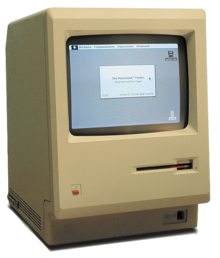
I was also reminded of the sheer joy of playing with fonts. I was a kid when the Apple Mackintosh was born and my computer geek dad had one of these:


I think we forget now how revolutionary the visual nature of the Mac operating system was - surely the late Steve Jobs's real legacy? Me and my best mate, the Pink Floyd fan (yes, you!), would play around on it for hours constructing newspapers and writing stories, making full use of the entire range of fonts available. San Francisco for the ransom notes, and Gothic for anything 'antique', of course. Happy days.


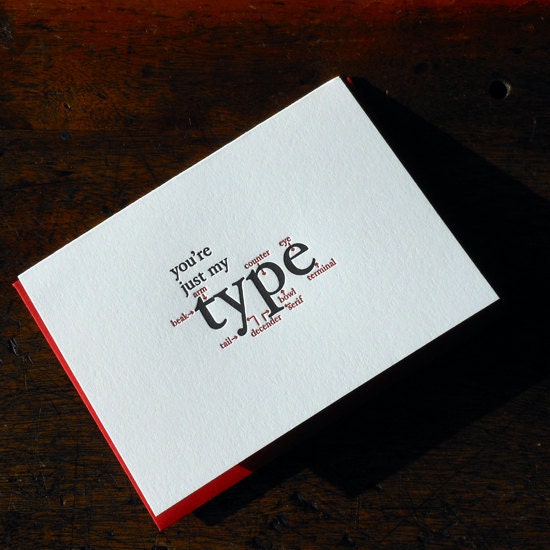
On the same theme, I just love this witty greetings card, a recent Etsy find ...


Saturday, 15 October 2011

New Addition

I picked this sweet vintage book up recently: I love books with dedications and old-fashioned illustrations. Can't decide whether to keep it or Etsy it. Maybe I'll just gaze at it for a while and then make up my mind...

Saturday, 2 October 2010

Retro Knitting

Having inherited this fabulous book from my mum,


I opened it up for the first time today, and found this collection of handwritten patterns - love the idea of inheriting something that has been tried, tested and annotated, like getting a secondhand book with a stranger's name and notes in, so personal and somehow "connected". Plus, if you look closely, you can see the book is one year older than me! It also contained this very stylish 80s lovely. 


It has some amazing photography: I especially like this motorcycle chick, modelling a sweater!


And this is very glamorous - but a cable knit bikini? Hardly practical!


I think I'll be sticking to hats for the moment ...

[http://www.thisbutterflymind.blogspot.com/]

Saturday, 19 June 2010

Tales of empire

soccer lessons
Uploaded to Flickr by zlandr

The Orange Prize marathon continues on, despite being overtaken by events - the Prize was carried by Barbara Kingsolver for The Lacuna. For once, I find myself wholeheartedly in agreement with a panel of literary judges. In the meantime, I have finished The White Woman on the Green Bicycle by Monique Roffey.

In exploring the politics of empire and the post-colonial turmoil of the British withdrawal from Trinidad through the portrayal of a marriage, Roffey turns to a predictable and not even uncommon trope for colonialism. And it has a strand of magic realism - groan - sprinkled throughout: the island is imagined as a voluptuous woman, shades of Garcia Marquez and shades of Hakluyt. Has imaging the colonies progressed no further in the occidental mind than the Elizabethans picturing America as Virginia, virgin land there for the despoliation? Has Said achieved nothing? Or is it all a clever ploy to depict the conflicted status of the non-native incomer, who feels Trinidadian but is not accepted by Trinidadians?

The writing is also a bit self-conscious: there’s a “creative writing evening class” non-linear narrative device which adds nothing, meaning that crisis comes too early and the second half is less savoured. At least, less savoured by me!

Having said that, on the whole, the writing was compelling if clunky: unsympathetic characters are well wrought and this was, for me, an affecting picture of the uneasy simmering tensions so typical of the multi-racial Caribbean. Perhaps more so because this happened to my family, with Jamaican independence, which promised so much and evolved into something quite different.

There was also a brief detour by way of The Guernsey Literary and Potato Peel Pie Society by Annie Barrows and Mary Ann Shaffer - sadly, Shaffer died and the novel was completed by her niece, Barrows. You can tell, but it doesn‘t matter. This is a sweetly charming epistolary novel about love, loss and friendship set in the aftermath of the Nazi occupation of the Channel Islands. Highly recommended if you need to feel optimistic and joyful. Unusual to read a modern novel in letters - I think Ella Minnow Pea was the last one I read - and I have been inspired to read Richardson’s Pamela because of it.

Friday, 4 June 2010

Oranges are not the only fruit?

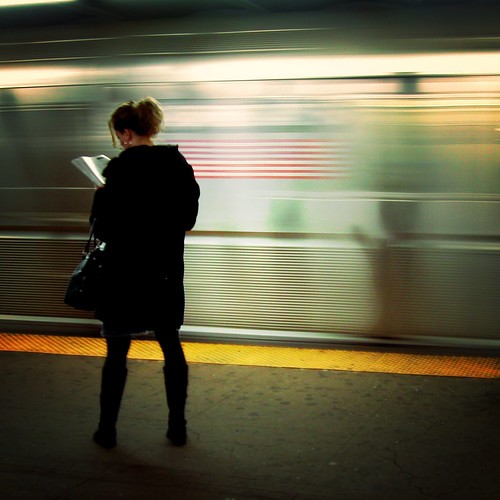
On the platform, reading


At work, our sort-of reading group is working through the Orange Prize shortlist.
I've steered clear of book clubs somewhat, reading from a list and to a prescribed time smacks of university days a little and can become joyless - reading to complete, not reading for pleasure.
Having struggled through a recent fiction dry spell – starting and abandoning unsatisfying novels and desultorily turning to a rather eccentric selection of non-fiction – I am embracing this structured project with gusto.
The shortlist is:
·         Rosie Alison - The Very Thought of You
·         Barbara Kingsolver - The Lacuna
·         Attica Locke - Black Water Rising
·         Hilary Mantel - Wolf Hall
·         Lorrie Moore - A Gate at the Stairs
·         Monique Roffey -The White Woman on the Green Bicycle
The awards ceremony is next week, so we don't stand a chance of completing the list in time – which poses interesting questions about how our judgement of literary value might be affected by the announcement of the prize winner.
So far, I've raced through The Lacuna and dawdled through The Very Thought of You.
The Lacuna was stunning, powerful and passionate, with a strong political message about personal freedoms and public perception, and the morality of public crusades.  It's very thought-provoking on the theme of active participation vs. passive observation in history-making events, proposing, I think, that there is no such thing as passive observations of the times – as an observer, you too are implicated.
The Very Thought of You was nice enough, I suppose, as a historical romance. I felt it was a bit thin, the wartime setting was primarily backdrop and added little to the narrative's drive other than to propel the characters into a sudden conclusion, rather awkwardly, two-thirds of the way through the novel.  The prose style was also a little unsatisfying, relying largely on rhetorical flourish and purplish descriptive passages. There could have been an exploration of the issue of personal morality in wartime, and of the role of the voyeur in the events they observe.
Ah, I've just noticed that observation, of intimate personal catastrophes and sweeping historical events, seems to be a common theme here!
Interestingly, my tweet about the project was picked up by the Orange Prize marketing team:
·         Me: First hand-out of books for new reading group, reading Orange Prize list - I got The Lacuna by Barbara Kingsolver http://ht.ly/1MxqF

·         Them: Let us know how your reading group gets on with the shortlist :-)
Now that's how to engage your audience and contribute to the conversation.  Basic courtesy, maybe, but I certainly felt all warm and cozy - and appreciated!

Thursday, 18 March 2010

Is there such a thing as too many books?

Image via Flickr (My Favorite Book Shop, originally uploaded by Lochaven)

The photo above is accompanied on its Flickr page, by a wonderfully apt Henry Ward Beecher quote: "Where is human nature so weak as in the bookstore?"

Having recently read this insightful piece by Toby Lichtig in The Guardian, 'Giving Up Book Shopping', I will hang my head in shame and admit I too have a problem...

I am so easily seduced in bookshops by the endless rows of unread books just waiting to have their spines cracked and their pages turned down, to have the new 'paper-and-glue' smell inhaled deeply.  I commoditise books - I read them too - but I love them a little too much as design objects, totems, possessions. I browse the bookish blogs and flick quickly back and forwards to my Amazon wishlist app (curse you, iPhone, for making it too easy to succumb), in search of the next wordy high.

I have rows and rows of floor-to-ceiling shelves - I'd love an oak panelled study with library ladders, but that's another story - yet still nowhere to put the ever-inceasing piles of books I've bought and never read.

To that end, a little Spring cleaning - this is a list of unread books currently taking up space that I bought with the nest of intentions but, for one reason and another, have never got around to reading.  The rule is, no Amazon till they're gone to a good home ... so, help me out, please claim any you'd like and, providing you're in the UK, I'll endeavour to get them to you. Otherwise, the charity shop beckons. 

Oh, and swaps welcome if you're looking to clear some shelf space yourself.

And last ditch impassioned pleas to give a book a second chance ("you simply must read it, it's beautiful") also welcome.

Carson McCullers - The Ballad of Sad Cafe
DBC Pierre - Vernon God Little
AS Byatt - Babel Tower
EA Markham - At Home with Ms Vanesa
Haruki Murakami - After the Quake
Iain Banks - Espedair Street
Philip K Dick - Do Androids Dream of Electric Sheep?
Siri Hustvedt - What I Loved
JM Coetzee - Summertime
Ali Smith - Hotel World
Joyce Carol Oates - We Were The Mulvaneys
Chimamanda Ngozi Adichie
- Purple Hibiscus

Sunday, 26 July 2009

Diagnosis, logophilia

This article in the Guardian Review examines words that 'make us merry', looking at sound symbolism.

We tend towards nice, soft sounds like "l", "m" and "n", dipthongs and polysyllabic words, and steer clear of hard sounds and short vowels. Apparently, dislike of certain words is called logophobia.

Discussion on the blog focused on hated words, from cliches to Americanisms and nouns as verbs, as well as phonetics. "Moist" was one of the most hated: interesting, it starts with soft sounds and a dipthong and ends with a hard sound.

Some of my favourite words are (in no particular order and in no way comprehensive!):
  • Palanquin
  • Luminous
  • Catatonic
  • Bride
  • Undulate
  • Arc
  • Ululate
  • Prolific
  • Mediaeval
  • Luscious
  • Lyrical
Lots of soft vowel sounds, but also juicy consonants and a heavy sway towards the Latinate ... Go figure!

Diagnosis, logophilia ...

Saturday, 25 July 2009

Feet of clay

Reading Claire Tomalin's biography of Ellen Ternan - the young actress for whom Dickens abandoned his wife - I discover the extent to which my literary hero had feet of clay.

Dickens' passionate social documentation, live-loving humour, celebration of human nature in all it's diversity, fierce commentary on justice, poor reform, institutions and the Establishment- all this remains unchanged but I am seeing his heroines with a new eye.

Revelations of Dickens' Byzantine deceit, sexual double standards and double-dealings, hypocrisy and of utterly indefensible cruelty to his poor wife. His relationship with Ternan casts his insipid, passive, blandly pretty child-wives and doll-like victims in a whole new (disturbing) light for me.

Following it up with a viewing of the 2007 ITV take on The Old Curiosity Shop - the heroine of which, Little Nell, is the ultimate in pliable pedestal women - you can see Dickens has trouble representing flawed, real womenkind on the page. From Dora to Estella, is that it?

Interestly, it isn't (of course) the novels that have altered but my reading - thanks, Barthes! Is it dangerous to read too much secondary material? Does it muddy the instinctive reading or lift the scales from your eyes?

I am currently embarking on the Brenda Maddox biography of George Eliot. Fingers crossed there is nothing here to change the way I see Middlemarch - I am quite happy with my present understanding! So far, so good: lots of burgeoning Radicalism and working as the first female editor in London, editing a high profile quarterly ...

Saturday, 7 March 2009

Dirty literary secrets


This short piece on guilty pleasure books caught my eye a few days ago: have to admit I've been sheepishly reading but hiding the above on my commute this week.

John Sutherland describes reading as one of "only three private acts left" ...

Wednesday, 25 February 2009

Art and Artists 2 - sketchbooks


Some interesting artists' sketchbooks on Design Sponge today, reminding me I haven't touched my sketchbook in a while ...

More over on Book By It's Cover: I especially like Claudia Pearson's dainty observational sketches, Katy Horan's folksy babushka types and Chad Kouri's hand-drawn typography.

LinkWithin

Blog Widget by LinkWithin